
Make it yours
Models & backends
Choose the tools. Choose where the work happens.
The architecture infographic shows how a request reaches native or ComfyUI compute and returns to the same gallery.
Know what’s installed
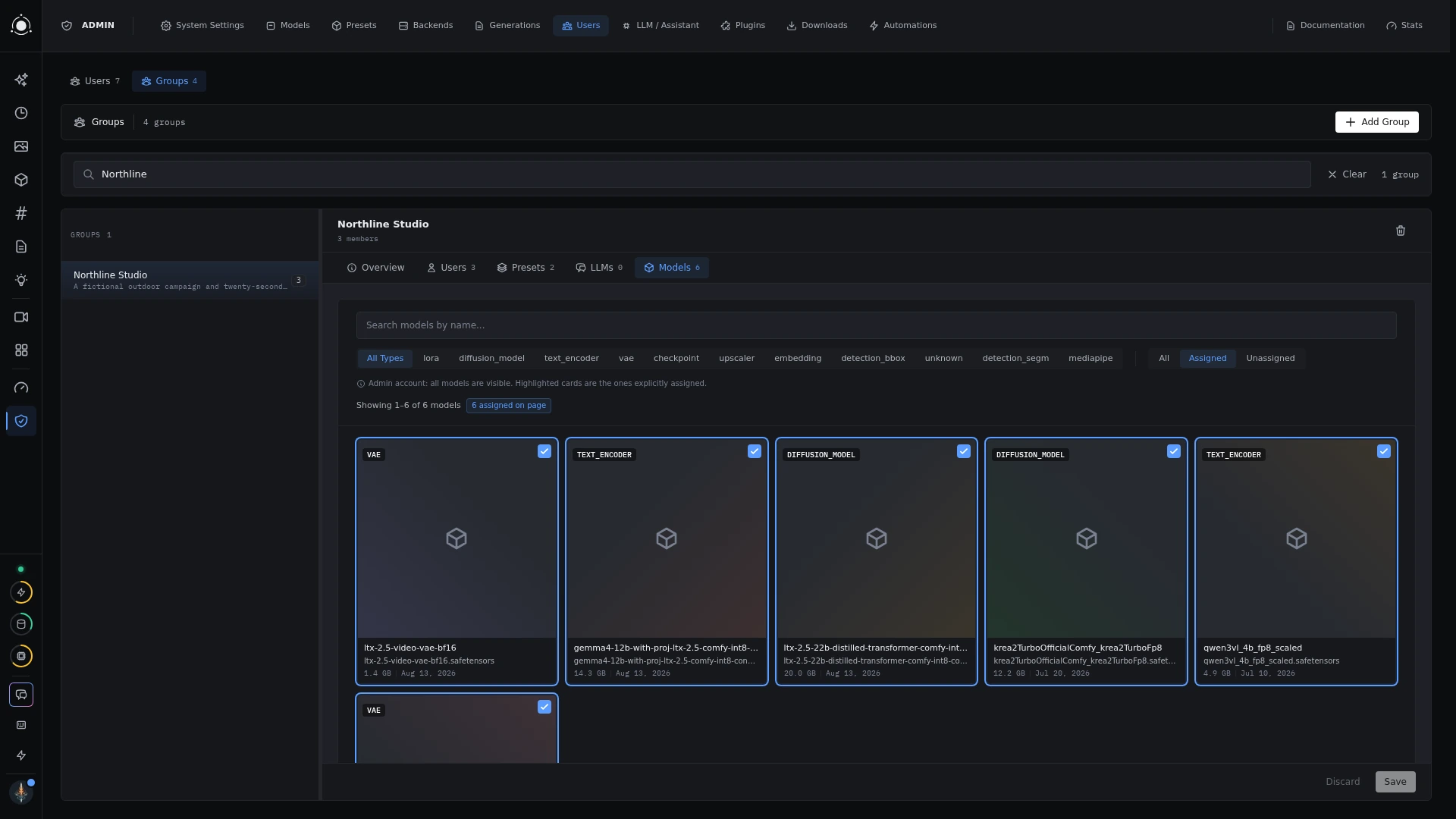
Models is the inventory of actual model files: base checkpoints, LoRAs, text encoders, VAEs, and upscalers. Filter by type, tag, or name. Open a model to inspect its size, details, previews, and generations made with it.
A preset’s model pickers show compatible files available to your account. Administrators manage downloads and assignments. Provider plugins can add metadata and download links from external catalogs.
 Model management
Connect the compute
An engine is the kind of pipeline a preset runs. A backend is a configured place that runs that engine. Native presets can run locally or on a compatible remote native worker; ComfyUI presets require a configured ComfyUI server.
Administrators configure and enable backends, connection details, and applicable device settings. A preset needs a backend that speaks its engine’s protocol. A remote setup lets the browser-facing studio and GPU worker live on different machines.
Memory needs vary by model, resolution, and workflow. Weights download separately and carry their own licenses. Use the hardware guide for model-specific requirements and validation status.